Smart hydration sleeve
Weight and motion sensing for a familiar cup, developed within an interdisciplinary research team.

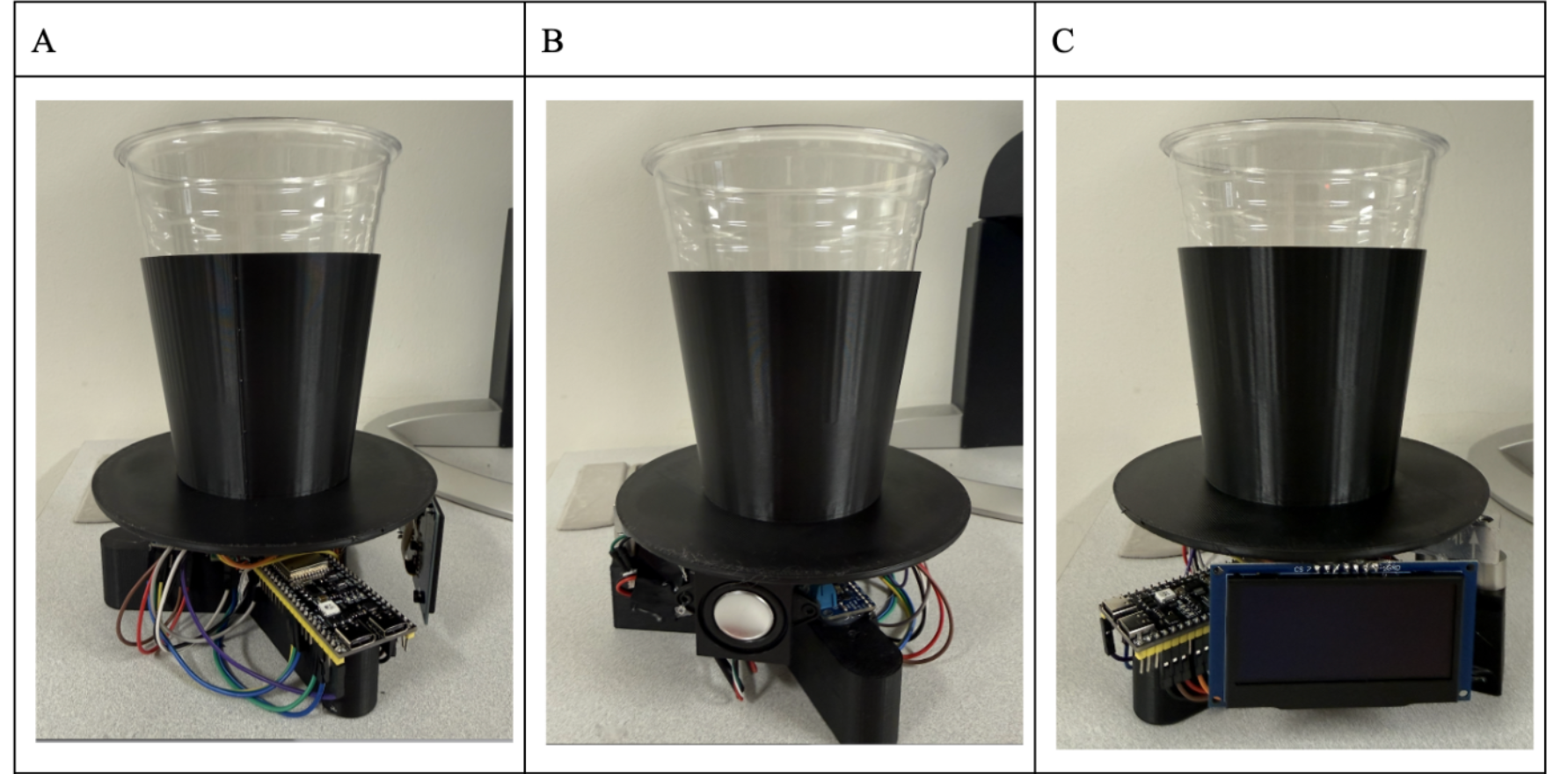
Measure intake without changing the cup.
The research project explores hydration monitoring and reminders for older adults. A cup-holder platform combines a load cell, HX711, inertial sensing, an ESP32-S3, an OLED display, and an amplified speaker.
My contributions include electronics integration, initial C++ logic for stable weight-change tracking and motion rejection, the custom HX711 PCB, and MATLAB analysis of reference-scale comparisons. The broader reminder firmware and system were developed by the team.
Use motion to decide when weight is meaningful.
A moving cup produces weight readings that should not be interpreted directly as intake. The sensing approach suppresses measurements during movement, waits for a stable state, and compares the new mass with the previous stable measurement to estimate consumption or refilling.
For water, the system uses the approximation of 1 g per 1 mL. This is an intake estimate based on observed mass changes, rather than a direct measurement of swallowing.
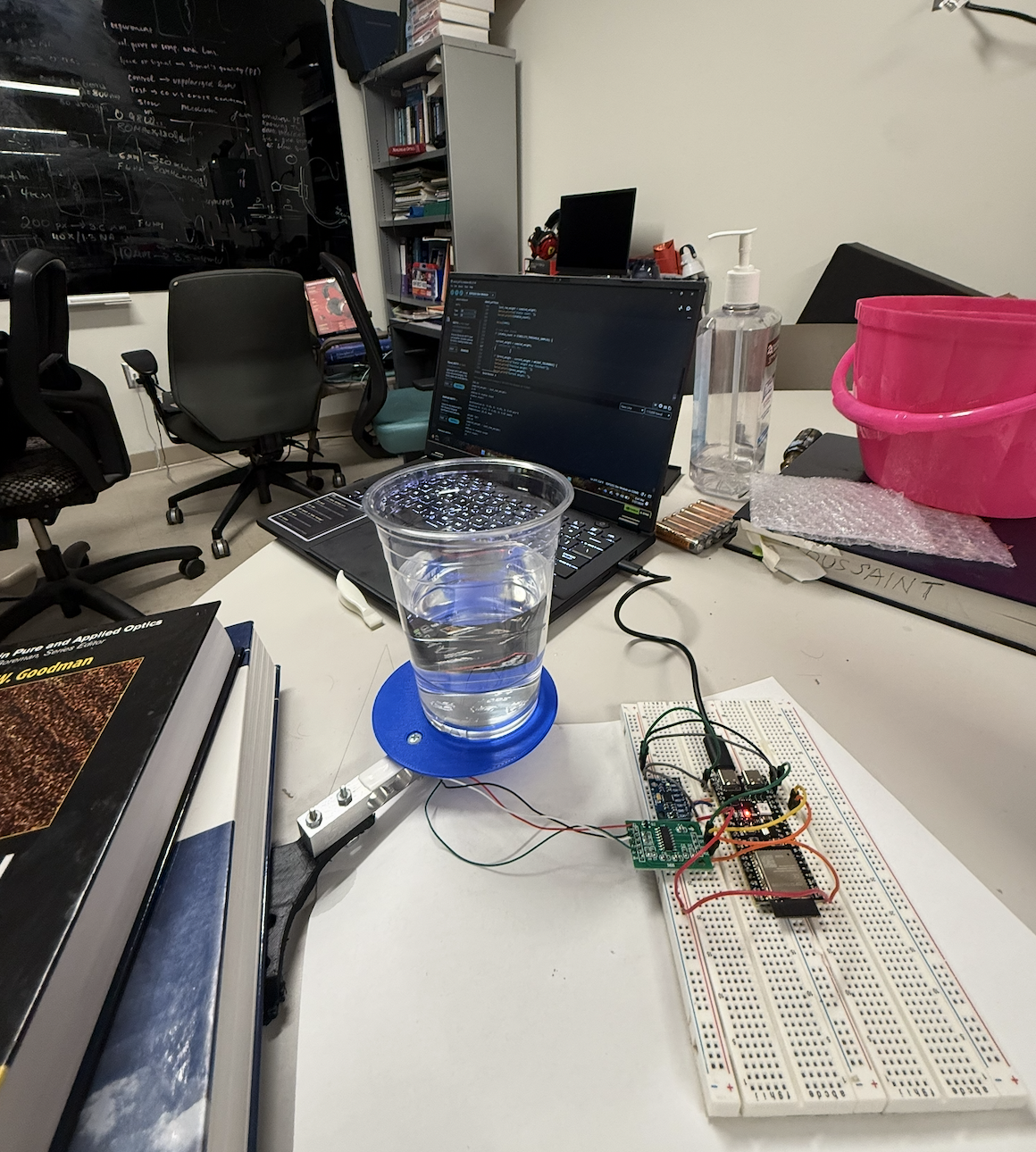
Consider the causes. Start with the simplest fix.
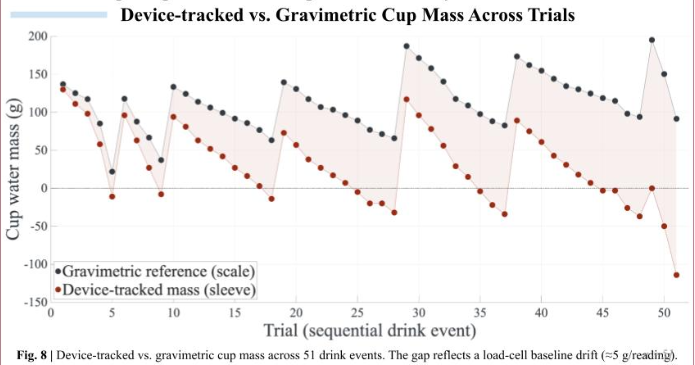
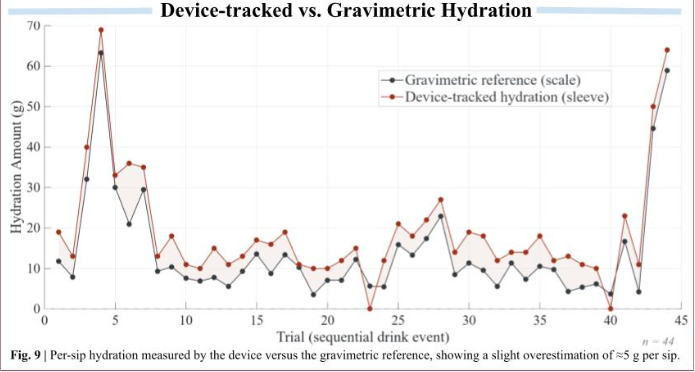
Comparing the prototype with a laboratory reference scale revealed a drifting cup-mass baseline and a mismatch in per-sip estimates. I analyzed the discrepancies in MATLAB; the two poster graphs below show this early behavior.
We considered several possible sources of the discrepancy. Improving the cup-to-sleeve coupling was the first and simplest intervention to try. It resolved the observed problem: the gap between device and reference measurements disappeared after the fix.
Other possible fixes remained part of our troubleshooting plan if the coupling change had not worked; they were not needed to resolve this issue in the proof of concept.
Turn the proof of concept into a compact platform.
The development-board prototype demonstrated weight and motion sensing together with display and audio feedback. The custom PCB builds on that working concept: replace separate boards and jumper wiring with a smaller, more integrated assembly that fits naturally into the sleeve.
So far, I have designed the HX711 front end and its PCB layout. Development of the rest of the integrated board is in progress.