Custom HX711 PCB
A custom load-cell front end for a compact hydration-monitoring system.
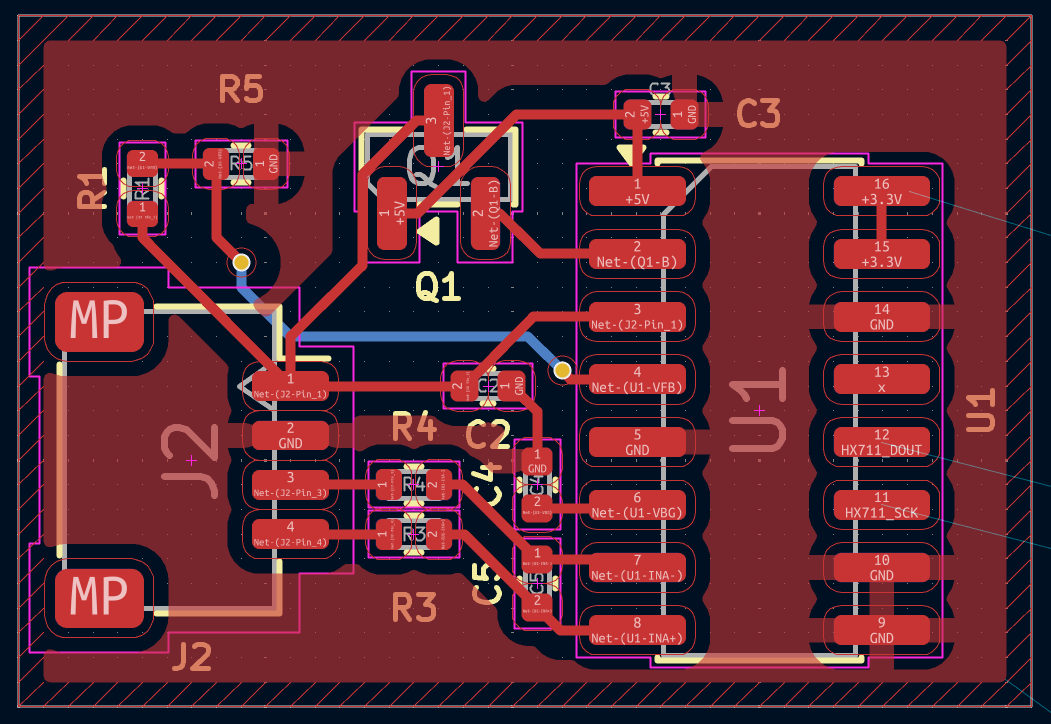
Design the sensing front end.
The breadboarded hydration sleeve demonstrated the sensing concept, but separate development boards and wiring limited how compact the device could become. I designed a custom HX711 interface as a first step toward a single integrated board.
Design choices and tradeoffs.
80 samples per second: a deliberate SNR tradeoff
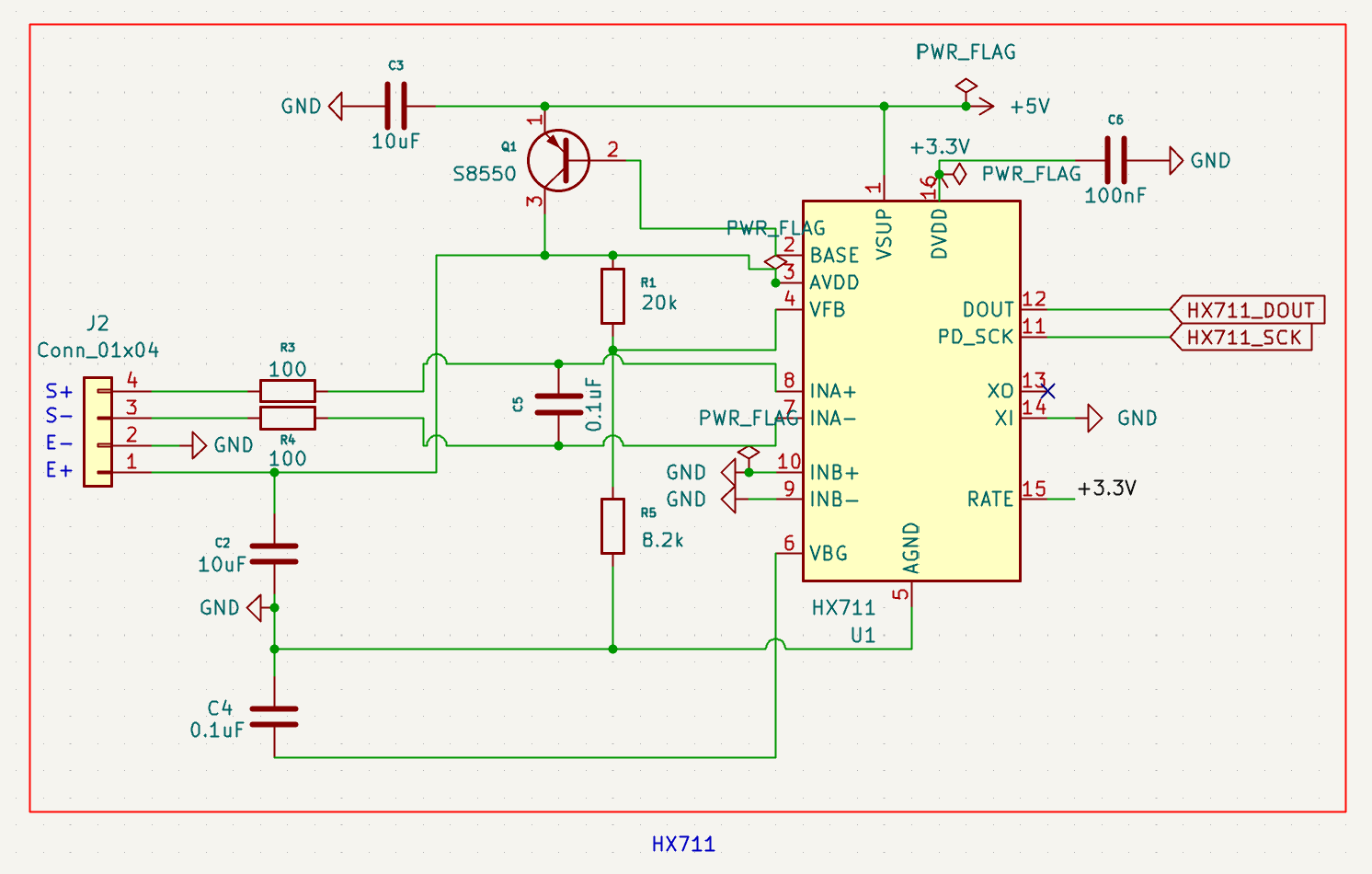
Moving from 10 to 80 samples per second gives finer temporal tracking of weight changes, with a documented reduction in signal-to-noise ratio. That tradeoff motivated the analog-supply design below. RATE is tied to 3.3 V DVDD to select 80 SPS.
Separate analog power from digital logic
To help offset the SNR penalty at 80 SPS, I designed around 5 V VSUP for higher load-cell excitation while keeping DVDD at 3.3 V for ESP32-compatible logic. A 20 kΩ / 8.2 kΩ feedback divider targets approximately 4.30 V AVDD. The goal is to increase the useful analog signal without raising the digital logic level.
Keep the front end focused
The internal oscillator avoids an external clock component. Each differential input uses a 100 Ω series resistor, with 100 nF across the inputs. Local supply decoupling and analog-component grouping support the front-end design.
Testing in progress.
The HX711 schematic and PCB layout are designed, and testing is in progress.
Continue the integrated design.
Continue developing the remaining circuitry and integrating it with the HX711 front end in the shared KiCad project.